 Add to Chrome
 Add to Firefox
 Add to Edge
PR2: Predictive Routing Replay for MoE-Based LLM Reinforcement Learning
May 29, 2026
Mixture of Experts (MoE) Large Language Models (LLMs) achieve strong performance at scale. However, reinforcement learning (RL) on MoE-based LLMs often suffers from training instability. A root cause is router drift, i.e., expert activations can change drastically across model updates and differ between disaggregated rollout and training phases, causing large rollout--training mismatch and unstable importance sampling weights in PPO-style RL algorithms. Routing replay mitigates this issue by freezing the replay route within each reasoning trajectory, but it ignores how the router evolves under off-policy updates and thus causes router staleness. To address this limitation, we propose Predictive Routing Replay (PR2), which augments each router with a lightweight evolution predictor that learns to anticipate short-horizon router evolution. During the rollout phase, we use the predictive routing distribution to apply top-$k$ routing, enabling gradients to reach experts that are likely to become active after updates. During the training phase, we replay the resulting predicted route to retain consistency for stable importance estimation. Theoretical analysis and experiments support that PR2 reduces routing-induced mismatch, improves RL stability, and yields stronger performance across various reasoning benchmarks.

EfficientLLM: Efficiency in Large Language Models
May 20, 2025Large Language Models (LLMs) have driven significant progress, yet their growing parameter counts and context windows incur prohibitive compute, energy, and monetary costs. We introduce EfficientLLM, a novel benchmark and the first comprehensive empirical study evaluating efficiency techniques for LLMs at scale. Conducted on a production-class cluster (48xGH200, 8xH200 GPUs), our study systematically explores three key axes: (1) architecture pretraining (efficient attention variants: MQA, GQA, MLA, NSA; sparse Mixture-of-Experts (MoE)), (2) fine-tuning (parameter-efficient methods: LoRA, RSLoRA, DoRA), and (3) inference (quantization methods: int4, float16). We define six fine-grained metrics (Memory Utilization, Compute Utilization, Latency, Throughput, Energy Consumption, Compression Rate) to capture hardware saturation, latency-throughput balance, and carbon cost. Evaluating over 100 model-technique pairs (0.5B-72B parameters), we derive three core insights: (i) Efficiency involves quantifiable trade-offs: no single method is universally optimal; e.g., MoE reduces FLOPs and improves accuracy but increases VRAM by 40%, while int4 quantization cuts memory/energy by up to 3.9x at a 3-5% accuracy drop. (ii) Optima are task- and scale-dependent: MQA offers optimal memory-latency trade-offs for constrained devices, MLA achieves lowest perplexity for quality-critical tasks, and RSLoRA surpasses LoRA efficiency only beyond 14B parameters. (iii) Techniques generalize across modalities: we extend evaluations to Large Vision Models (Stable Diffusion 3.5, Wan 2.1) and Vision-Language Models (Qwen2.5-VL), confirming effective transferability. By open-sourcing datasets, evaluation pipelines, and leaderboards, EfficientLLM provides essential guidance for researchers and engineers navigating the efficiency-performance landscape of next-generation foundation models.
Mora: Enabling Generalist Video Generation via A Multi-Agent Framework
Mar 22, 2024
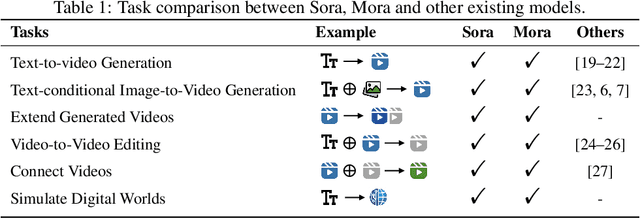


Sora is the first large-scale generalist video generation model that garnered significant attention across society. Since its launch by OpenAI in February 2024, no other video generation models have paralleled {Sora}'s performance or its capacity to support a broad spectrum of video generation tasks. Additionally, there are only a few fully published video generation models, with the majority being closed-source. To address this gap, this paper proposes a new multi-agent framework Mora, which incorporates several advanced visual AI agents to replicate generalist video generation demonstrated by Sora. In particular, Mora can utilize multiple visual agents and successfully mimic Sora's video generation capabilities in various tasks, such as (1) text-to-video generation, (2) text-conditional image-to-video generation, (3) extend generated videos, (4) video-to-video editing, (5) connect videos and (6) simulate digital worlds. Our extensive experimental results show that Mora achieves performance that is proximate to that of Sora in various tasks. However, there exists an obvious performance gap between our work and Sora when assessed holistically. In summary, we hope this project can guide the future trajectory of video generation through collaborative AI agents.